Memory Keepers: The Diaspora Creators Racing to Catch Our Stories Before They're Gone
There's a particular kind of grief that doesn't have a name yet. It's the feeling you get when you realize you never asked your grandmother how she left. Never recorded the way she described the market sounds back home, or the name of the village elder who blessed her before the journey. That knowledge — irreplaceable, irreducible — went with her. And nobody wrote it down.
Across the United States, a generation of diaspora creators has decided that grief stops here. Armed with microphones, hard drives, and an almost obsessive commitment to memory, they're building something extraordinary: a living, distributed archive of Black diasporic life. Not for museums. Not for academic journals. For us.
What a Griot Actually Does
In West African tradition, the griot isn't just a storyteller. They're a living database — the person a community trusts to hold its genealogies, its conflicts, its victories, its shame, and its pride across generations. The role is sacred because the stakes are real. Lose the griot, lose the thread.
Migration is, in many ways, the ultimate griot crisis. When families scatter across continents — from Lagos to London to Atlanta, from Accra to Amsterdam to the Bronx — the chain of transmission breaks. Kids grow up between worlds, fluent in English but not in the stories that explain who they are. The elders who carry those stories age without anyone asking the right questions in time.
What's happening now, though, is something genuinely new. The tools of digital creation have handed a generation of diaspora makers the ability to do what the old griots did — but at scale, across borders, and with receipts.
The Podcasters Asking the Questions We Should Have Asked
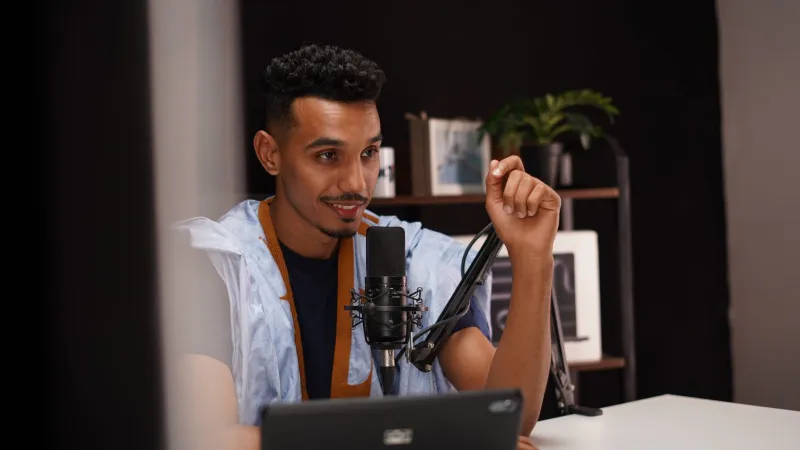
Podcasting has quietly become one of the most powerful preservation tools the diaspora has. Shows built around intergenerational interviews — where hosts sit down with parents, grandparents, community elders, and first-generation immigrants — are capturing testimony that would otherwise exist only in living memory.
What makes these shows different from mainstream oral history projects is intimacy. These aren't researchers extracting data. These are children and grandchildren finally asking their people to talk — about the crossing, the arrival, the confusion, the hustle, the homesickness, the pride. The recordings feel less like archives and more like long-overdue conversations.
Some of these podcasters are building searchable databases around their episodes, tagging content by country of origin, decade, and theme so that diaspora members can find stories that mirror their own families' trajectories. That's not just content creation. That's infrastructure.
Documentarians Who Go Back So We Don't Forget
Then there are the filmmakers. A growing number of diaspora documentarians — many of them based in cities like Houston, Chicago, and the DMV — are making the trip back to ancestral homelands specifically to capture what's still there before it isn't.
They're filming aging community leaders. Recording traditional ceremonies. Sitting with grandmothers who still know the songs that haven't been sung in decades. And crucially, they're bringing that footage back to diaspora communities in the US and sharing it not through film festival circuits, but through YouTube, Instagram, and community screenings in church halls and cultural centers.
The distribution model matters. When a documentary about a Yoruba naming ceremony plays at a Lincoln Center screening, it reaches a certain audience. When it shows up in a Nigerian-American community group chat in Maryland with a link and a timestamp, it reaches the people whose lives it's actually about.
Digital Archivists and the Libraries Nobody Built for Us
Perhaps the most quietly radical work is happening in the archiving space. Across platforms — from dedicated websites to TikTok accounts to collaborative Google Drives that somehow became community institutions — digital archivists are collecting photographs, letters, recordings, recipes, proverbs, and oral testimonies and making them searchable, shareable, and free.
Some of this work is hyperlocal. There are archives dedicated specifically to the Ghanaian community in the DC metro area, or to Haitian families who came through Miami in the 1980s, or to Senegalese merchants who built communities in Harlem. The specificity is the point. Broad strokes don't preserve culture. Details do.
Others are building tools — apps, browser extensions, community platforms — that make it easier for everyday diaspora families to contribute their own materials. The vision is participatory: not a top-down archive curated by experts, but a living collection that grows every time someone uploads a scanned photograph or records a voice memo of their uncle explaining how things were done back home.
Why This Matters More Than It Might Seem
It's easy to frame this work as nostalgic. A look backward. But that's exactly the wrong read.
What these creators are actually doing is building identity infrastructure for future generations. The children of the diaspora who grow up with access to recorded testimonies, digitized family photographs, and documented cultural practices have something concrete to stand on. They know where they come from in a way that isn't just vibes — it's evidence.
That matters politically. It matters psychologically. And it matters culturally, because communities that know their own history are harder to erase, harder to dismiss, and harder to define from the outside.
There's also something happening across borders that's worth naming. These digital archives aren't just serving diaspora communities in the US — they're connecting African Americans to continental Africans, Caribbean communities to West African ones, and second-generation immigrants to cousins they've never met but whose stories suddenly feel familiar. The Afropole, in the truest sense: a pole of connection that the physical world made difficult but the digital world makes possible.
Carrying the Thread Forward
The urgency is real. Every year, elders pass without being recorded. Every year, children grow up with gaps where their history should be. The window isn't closing — it has been closing for decades — but it isn't shut yet.
What's remarkable about this moment is that the people doing this work aren't waiting for grants, institutions, or recognition. They're doing it because they understand, viscerally, what's at stake. A podcast recorded in a Brooklyn apartment. A documentary shot on a mirrorless camera in a village outside Kumasi. A shared folder of scanned photographs that somehow became a community's most precious resource.
This is what the modern griot looks like. Not performing at a royal court, but uploading at midnight, tagging metadata, and answering DMs from strangers who just heard their grandmother's story in someone else's voice for the very first time.
The stories are still here. Barely, sometimes. But they're here. And the memory keepers are working.