No Permission Needed: Black Collectors Are Building an African Art World on Their Own Terms
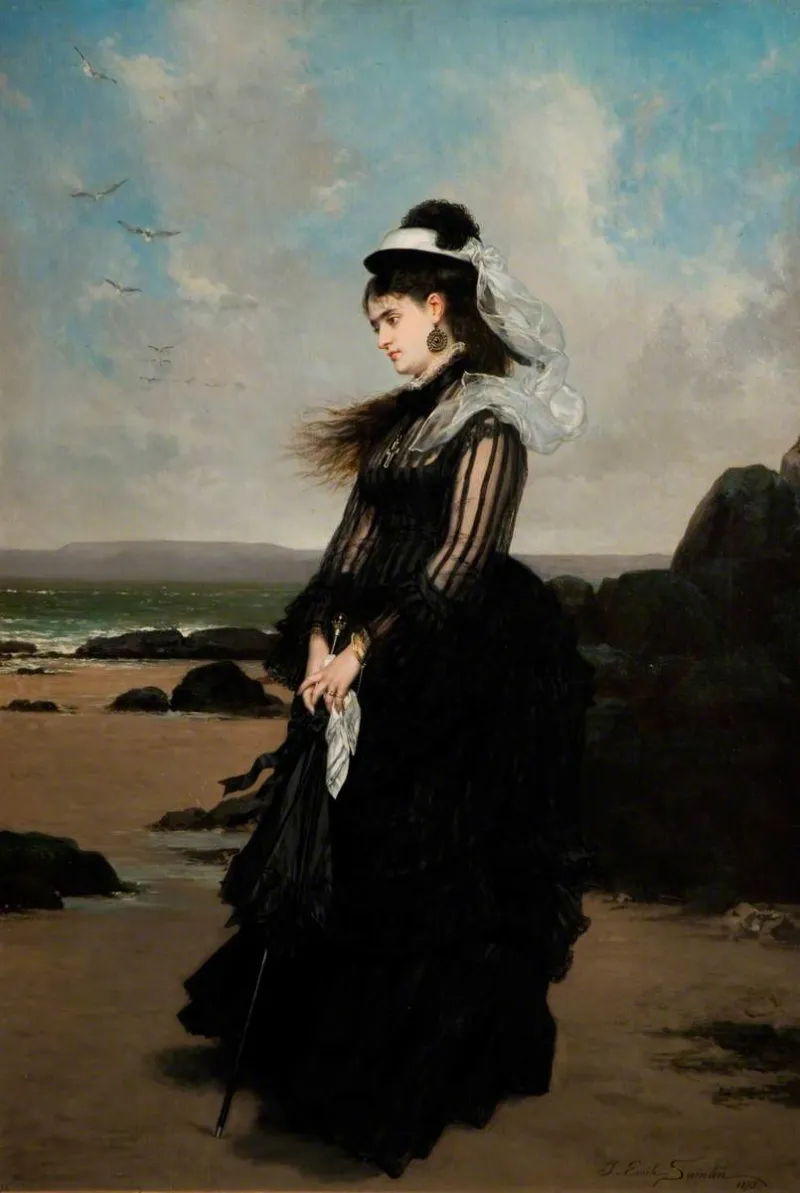
Photo: Jules-Émile Saintin, Public domain, via Wikimedia Commons
Let's be honest about something the mainstream art world would prefer to keep quiet: for decades, African art was only considered "serious" when a white institution said so.
A painting by a Lagos-based artist would hang unseen in their studio until a European gallery deigned to show it. A Nairobi sculptor's work would circulate through diaspora community spaces, beloved and celebrated, but invisible to the market mechanisms that generate real wealth and lasting legacy. The gatekeeping wasn't subtle. It was the entire architecture of the system.
That architecture is cracking. And the people doing the cracking are Black Americans and diaspora entrepreneurs who have decided, collectively and with increasing financial muscle, that they don't need the establishment's blessing to build something extraordinary.
A New Kind of Patron
The image of the art collector in America has historically been one thing: wealthy, white, and operating through institutions like Christie's or MoMA as the arbiters of taste and value. That image is being actively dismantled.
Across the country — in Atlanta, Houston, Washington D.C., Los Angeles, and New York — a generation of Black professionals, tech entrepreneurs, entertainment executives, and small business owners are quietly assembling collections of contemporary African art that would make any major museum envious. They're not doing it for social cachet. They're doing it because they understand something fundamental: culture is an asset, and for too long, Black communities have been encouraged to consume culture rather than own it.
These aren't passive collectors waiting for the market to tell them what to buy. They're doing their own research, traveling to Dakar, Johannesburg, and Abidjan to meet artists directly. They're building relationships with curators in Lagos and Nairobi. They're using social media — particularly Instagram, where African contemporary art has found a massive and engaged audience — to discover emerging voices years before any Western gallery comes calling.
The result is a shadow art market that is becoming less shadow by the day.
Why This Moment Is Different
Black Americans have always appreciated African art. What's different now is the economic capacity to do something serious with that appreciation, combined with a cultural confidence that simply wasn't as widespread a generation ago.
The Black wealth conversation in America has shifted. A growing class of Black professionals and entrepreneurs, many of them with direct diaspora connections, are actively looking for ways to deploy capital that aligns with their values and their identity. Investing in African art checks multiple boxes: it's financially interesting (contemporary African art has been one of the stronger performing segments of the global art market over the past decade), it's culturally meaningful, and it creates direct economic pathways for artists who are doing genuinely world-class work.
There's also a generational reckoning happening around legacy. Older generations of Black Americans built wealth through real estate and business ownership. The current generation is asking what comes next — what do we leave behind, what stories do we tell through what we collect, what does our version of a Rockefeller collection look like? For many, the answer involves African contemporary art at its center.
The Gallery Builders
Collecting is one thing. Building institutions is another level entirely — and that's where the story gets genuinely exciting.
Across major American cities, Black-owned galleries with explicit missions around African and diaspora art are establishing themselves as serious players. These aren't vanity projects. They're professionally run spaces with rigorous curatorial standards, strong artist relationships, and growing collector bases that extend well beyond Black communities.
What makes these galleries different isn't just their ownership — it's their framework. They don't approach African art as something exotic that needs to be explained to a Western audience. They approach it as contemporary art, full stop, created by artists who are in conversation with global movements while remaining deeply rooted in their own contexts. That framing shift matters enormously, both for how the work is presented and for how it's priced and positioned in the market.
Artists who show in these spaces often describe the experience as fundamentally different from working with European or white American galleries. There's no exoticization. There's no pressure to make work that "reads" as African in ways that satisfy a Western fantasy. There's just the work, taken seriously on its own terms.
Challenging the Validation Myth
Here's the opinion part, and we're not going to soften it: the idea that African art needs Western institutional validation to be considered significant is one of the most persistent and damaging myths in the global art world. And it's a myth that has cost African artists — and African economies — immeasurable wealth.
When a Congolese painter's work gets "discovered" by a Paris gallery and suddenly commands six-figure prices, where does that money go? Who built the relationship that made the sale possible? Who gets the long-term benefit of that artist's career trajectory? Too often, the answers to those questions lead away from the African art ecosystem and toward European intermediaries who added less value than they extracted.
Diaspora collectors and gallery owners are disrupting that flow. By building direct relationships with artists, by creating market infrastructure that lives within the African and African American community, they're keeping more of the economic value inside the ecosystem. That's not a small thing. That's wealth generation with a cultural multiplier effect.
The Artists Who Benefit
At the center of all this are the artists themselves — and their experiences are worth centering explicitly.
For a young painter in Kumasi or a photographer in Dakar, having access to diaspora collectors and galleries means something concrete: it means not having to wait for a European institution to validate your career before you can sustain yourself financially. It means having collectors who understand your cultural references without needing them explained. It means building a career on a foundation that isn't dependent on the whims of a market that has historically treated African art as a category rather than a collection of individual artistic visions.
Many artists describe diaspora collectors as their most engaged audiences — people who come to studio visits with genuine curiosity, who share work in their networks with authentic enthusiasm, who collect with an understanding of context that enriches the relationship between artist and patron.
Building the Infrastructure of the Future
What's being built right now, across living rooms and gallery walls and Instagram grids and private collection storage facilities in the American South and Northeast, is an infrastructure. It's messy and distributed and doesn't have a single headquarters or a marquee name attached to it yet. But it is real, and it is growing.
The Afropole has always understood that the diaspora's power lies in its connections — to the continent, to each other, and to a shared cultural inheritance that no institution can grant or revoke. What Black collectors and gallery builders are doing in the American art world right now is an expression of that power in one of its most tangible forms.
They're not asking for a seat at the table. They're building a different table entirely. And the art hanging on the walls around it is absolutely stunning.